Precision in Optical Analytics
Fiber Solutions for
High accuracy, stable signal quality, and low losses are essential in microscopy and spectroscopy. Optical fibers enable precise measurements, controlled illumination concepts, and reliable imaging – whether in pharmaceutical research, medical diagnostics, or industrial analysis.
CeramOptec develops and manufactures optical fibers and OEM assemblies for stable, reproducible light transmission across defined wavelength ranges. In addition, we tailor fiber configurations to the requirements of microscope systems, analytical platforms, and portable devices. This helps OEM manufacturers integrate fiber optic solutions into their analytical instruments.
Typical Applications
- Raman spectroscopy: precise signal transmission for detecting the smallest molecules
- Fluorescence analysis: reliable results in research, diagnostics and life sciences
- UV/VIS/NIR measurements: wide spectral coverage for versatile applications
- Microscopy: from confocal imaging to UV microscopy
- Laboratory & process analytics: stable light guidance for reproducible measurements
Custom Fiber Assemblies for Spectroscopy
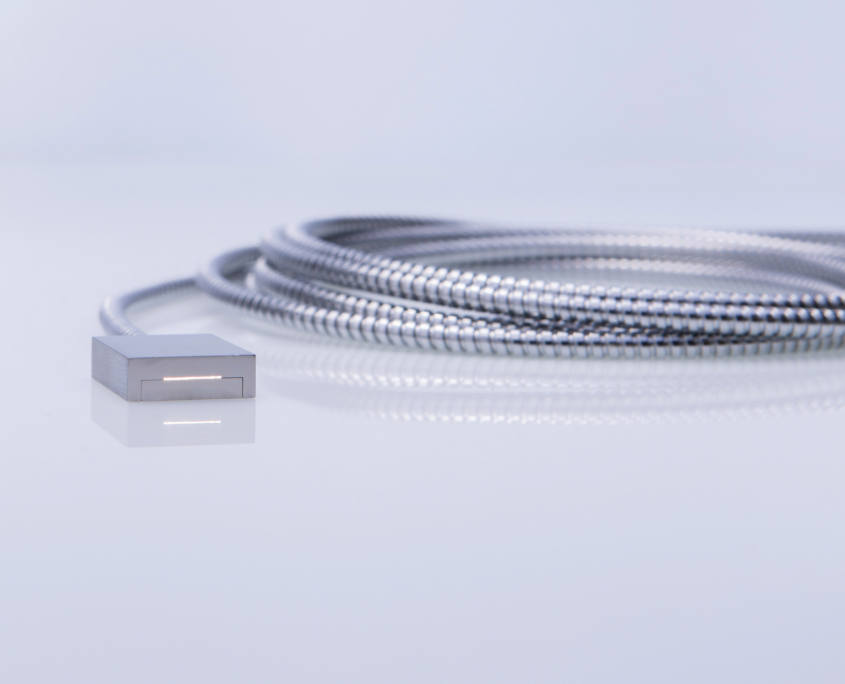
CeramOptec manufactures custom multi-fiber assemblies for spectroscopy and analytical systems. Depending on the optical setup, we arrange fibers in application-specific geometries to match optical interfaces, measurement configurations, and system requirements.
Available configurations include circular, semicircular, square, rectangular, linear, ring, and segmented-ring arrangements. In addition, we offer single-, dual-, and multi-branch designs as well as glued, fused, sorted, and AR-coated bundle configurations. For applications requiring defined spatial mapping, sorted fiber configurations support the assignment of individual fibers to specific measurement positions.
Selection Criteria for Fibers
Fiber selection for microscopy and spectroscopy depends on the wavelength range, optical system design, and signal stability requirements. Therefore, matching the fiber properties to the specific measurement or imaging task is essential. For UV-based applications, solarization resistance is another important selection criterion.
Key selection parameters:
- Wavelength range: UV, VIS or NIR transmission
- Solarization resistance: relevant for UV-based microscopy and spectroscopy
- Numerical aperture: coupling efficiency and signal quality
- Stability: reproducible performance under real operating conditions
Suitable Optran® Fibers
Depending on the analytical method and spectral range, the following Optran® fibers are commonly used in microscopy and spectroscopy applications:
- Optran® UV / UVNS / UVNSS
These fibers support UV microscopy and spectroscopy applications that require high solarization resistance and material purity. - Optran® UVWFS
This broadband fiber supports spectroscopy systems requiring low attenuation across UV, VIS, and NIR wavelengths. - Optran® WF / WFNS / WFGE
These fiber families provide stable transmission for VIS and VIS–NIR microscopy, analytical instruments, and imaging systems.
Explore suitable Optran® fiber types and technical details in our fiber overview.
FAQ – Frequently Asked Questions
What are fiber optic arrays used for in spectroscopy?
Fiber optic arrays enable multiple optical fibers to be arranged in a defined geometry for light delivery, collection or spatial mapping in spectroscopy systems. Depending on the optical setup, fibers can be arranged in circular, semicircular, square, rectangular, linear, ring or segmented-ring configurations. CeramOptec manufactures custom multi-fiber assemblies with application-specific fiber arrangements.
Which optical fibers are suitable for spectroscopy?
The suitable optical fiber depends primarily on the wavelength range, numerical aperture, solarization resistance and required signal stability. CeramOptec offers fibers for spectroscopy from the deep UV through VIS to NIR, including Optran® UV/UVNS/UVNSS, broadband Optran® UVWFS and Optran® WF/WFNS/WFGE for different spectral requirements.
Which optical fibers are suitable for Raman spectroscopy?
Fiber selection for Raman spectroscopy depends on the excitation wavelength, required spectral range and signal level. CeramOptec offers different Optran® fiber types for UV, VIS and NIR transmission, allowing the fiber properties to be matched to the specific Raman spectroscopy system and measurement requirements.
Can fiber bundles be customized for spectroscopy systems?
Yes. CeramOptec manufactures custom multi-fiber assemblies with application-specific geometries, branch designs and fiber configurations. Options include circular, semicircular, square, rectangular, linear, ring and segmented-ring arrangements as well as single-, dual- and multi-branch designs. Glued, fused, sorted and AR-coated configurations are also available.
How can sorted fiber bundles improve spectroscopy measurements?
Sorted fiber bundles enable defined spatial mapping of individual fibers and can improve measurement precision. They can also support an even power distribution across multiple bundle arms, making them useful for optical systems where reproducible channel assignment and light distribution are important.
