Deep UV Optical Fibers

Engineered for Reliable Performance in Demanding Applications

Deep UV applications place exceptional demands on optical fibers and fiber assemblies. Reliable UV transmission, reduced solarization and long-term stability are essential for consistent system performance. From material selection to fiber geometry, every parameter contributes to the characteristics of the finished fiber. Non-circular core geometries can further support beam homogenization and adaptation to specific light source or detector geometries.

CeramOptec develops and manufactures specialty optical fibers and assemblies engineered to meet these challenges.
OPTRAN® Deep UV Fiber Portfolio

CeramOptec’s OPTRAN® UV fiber portfolio combines material expertise, manufacturing consistency and application-specific configurations for demanding Deep UV applications.

The following key characteristics highlight what sets our fibers apart.

Chart-area Chart-area

Reliable Performance

Stable UV transmission supported by controlled manufacturing and reproducible fiber characteristics.

Adjust Adjust

Reduced Solarization

Optimized fiber designs help reduce solarization effects during prolonged Deep UV exposure.

Customization

Core Diameter, NA, Coating and Core geometry can be tailored to your application, including non-circular cores (NCC).

Tools Tools

Manufacturing

In-house manufacturing from preform to finished fiber assemblies ensures consistent process control.

Material & UV Performance

Deep UV performance depends on material properties, fiber design and operating conditions. Different applications place different demands on spectral range, UV stability and fiber configuration.

CeramOptec’s OPTRAN® UV fiber portfolio supports UV spectroscopy, fluorescence analysis, semiconductor processing and UV light delivery, as well as a broad range of other analytical, industrial and scientific applications.

  • Material Selection

    High- and low-OH silica compositions are selected according to the required spectral range and application.

  • Reduced Solarization / UV Stability

    Optimized fiber designs help maintain stable transmission during prolonged UV exposure.

  • Hermetic Carbon Layer

    UVNSS fibers use hydrogen loading and a hermetic carbon layer for enhanced resistance to solarization over time.

Choosing the Right Deep UV Fiber

All three fiber types support Deep UV transmission, but differ in spectral range, resistance to solarization and long-term stability. The optimal choice depends on the specific requirements of your application.

Chart-area Chart-area

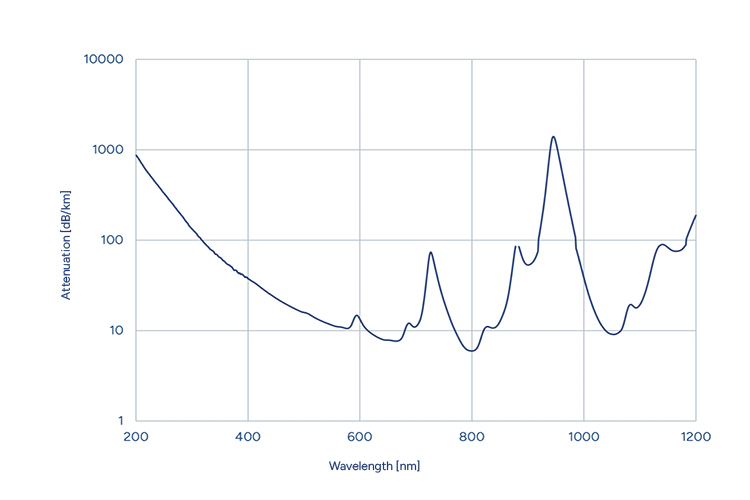
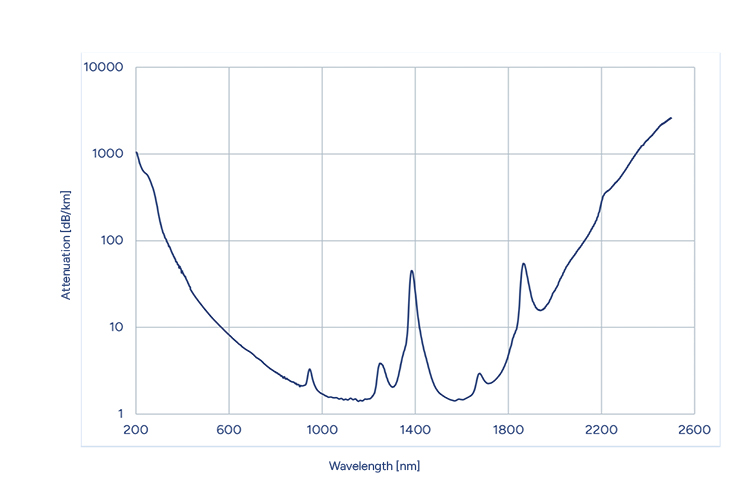
OPTRAN® UVWFS

Broad Spectral Coverage

Deep UV to NIR transmission from 200 to 2000 nm. Designed for applications requiring broad spectral coverage or multi-wavelength transmission.

Chart-area Chart-area

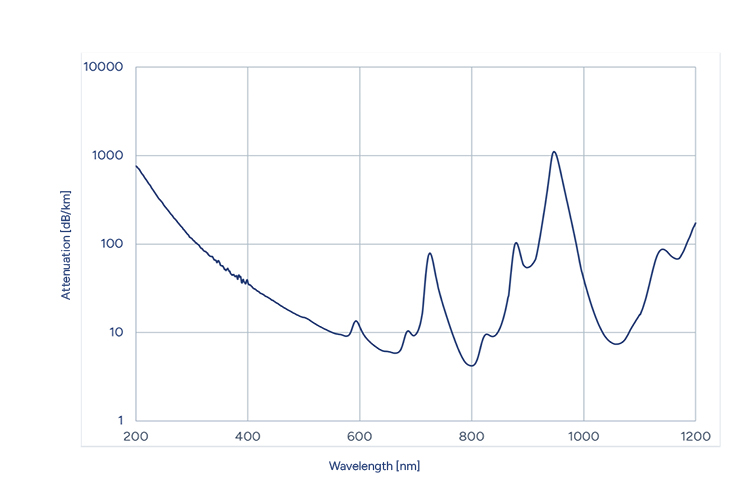
OPTRAN® UVNS

Enhanced UV Stability

Deep UV transmission from 190 nm with enhanced resistance to solarization. Designed for prolonged UV exposure where stable optical transmission over time is required.

Chart-area Chart-area

OPTRAN® UVNSS

Long-Term Deep UV Stability

Deep UV transmission from 190 nm with hydrogen loading and a hermetic carbon layer. Designed for demanding applications requiring enhanced long-term stability under UV or radiation exposure.

Selecting the right Deep UV fiber can be challenging.

Every Deep UV application has unique optical, mechanical and environmental requirements. Our fiber experts can help you identify the most suitable OPTRAN® fiber configuration for your application.

Manufacturing Expertise

Deep UV optical fiber performance depends on far more than the raw material alone. High-OH silica, preform manufacturing, fiber drawing and process control all influence the optical properties, long-term stability and reproducibility of the finished fiber.

CeramOptec combines extensive expertise in specialty optical fiber development with complete in-house manufacturing – from High-OH silica preforms to finished fiber assemblies. By controlling every stage of the manufacturing process, CeramOptec supports supports reproducible optical and mechanical fiber characteristics, consistent product quality and application-specific fiber solutions for demanding Deep UV applications.

  • Preform Manufacturing

    High-OH silica preforms manufactured in-house.

  • Fiber Drawing

    Controlled fiber drawing for reproducible optical properties.

  • Coating & Proof Testing

    Application-specific coatings and proof testing.

  • Assemblies & Integration

    Customized fiber assemblies for OEM integration.

Technical Resources & Datasheets

Access detailed product documentation, technical specifications and additional resources for the OPTRAN® UV fiber portfolio.
Can’t find the information you’re looking for? Our team is happy to provide additional technical data and application support.

OPTRAN® UVWFS Datasheet

Click to download technical specifications.

OPTRAN® UVNS Datasheet

Click to download technical specifications

OPTRAN® UVNSS Datasheet

Click to download technical specifications.

FAQs

OPTRAN® UVNS fibers are optimized for long-term UV transmission through a specialized High-OH silica design that reduces solarization during prolonged UV exposure.

OPTRAN® UVNSS fibers build on this design by combining a hydrogen-loaded High-OH silica core with a hermetic carbon layer. The carbon layer helps retain hydrogen within the fiber, supporting improved resistance to solarization during extended operation in demanding Deep UV applications.

The most suitable fiber depends on wavelength, expected UV dose and long-term performance requirements.

Selecting the right Deep UV optical fiber depends on more than wavelength alone. Expected UV exposure, operating conditions, required transmission stability, core diameter, numerical aperture, coating material and connector configuration all influence long-term system performance.

Our engineering team supports customers in selecting the most suitable OPTRAN® UV fiber configuration for laboratory, industrial and OEM applications.

A hermetic carbon layer is recommended for applications requiring maximum resistance to solarization during prolonged Deep UV exposure. UVNSS fibers combine hydrogen loading with a hermetic carbon layer that helps retain hydrogen within the fiber over time, supporting improved long-term UV performance in demanding operating environments.

Hydrogen loading helps stabilize the optical properties of High-OH silica fibers during prolonged Deep UV exposure. In OPTRAN® UVNSS fibers, the hydrogen is retained by a hermetic carbon layer, helping reduce solarization effects over time and supporting consistent optical transmission in demanding UV applications.

OPTRAN® UV fibers are available with core diameters ranging from 50 to 3000 µm, depending on fiber type. Standard numerical apertures include 0.12, 0.22 and 0.28, while additional configurations can be discussed for specific application requirements. Detailed specifications are available in the individual product datasheets.

Yes. OPTRAN® UV fibers can be configured with different core diameters, cladding ratios, numerical apertures, coating materials and proof test levels. Custom fiber configurations are available for prototype development as well as high-volume OEM production.

Yes. In addition to bare optical fibers, CeramOptec manufactures customized fiber assemblies including connectorized fibers, fiber cables and application-specific optical solutions. Assemblies are developed and manufactured in-house to match the optical and mechanical requirements of each application.

Discuss your Deep UV application with our fiber experts

Every Deep UV application has unique optical, mechanical and environmental requirements. Our fiber experts can help you identify the most suitable OPTRAN® fiber configuration for your application.

Contact us.